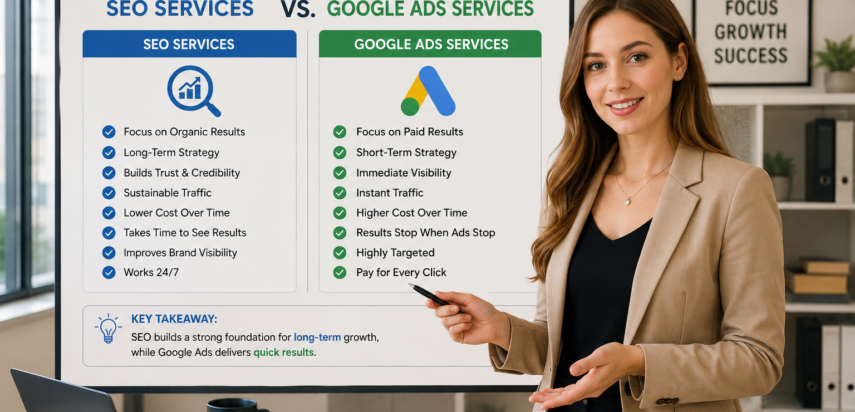
If you’ve ever sat down to plan your digital marketing budget, you’ve probably hit the same crossroads almost every business owner faces: Should I invest in SEO, or should I run Google Ads?
It’s a fair question, and honestly, the answer isn’t as simple as picking one over the other. Both channels live inside the same Google ecosystem, but they work in fundamentally different ways, attract different kinds of attention, and produce results on completely different timelines.
After years of working with small businesses, eCommerce stores, and service providers, one thing has become clear to me: most owners don’t struggle because SEO or Google Ads “doesn’t work.” They struggle because they pick the wrong channel for the stage their business is in.
This guide breaks down everything you actually need to know — costs, timelines, ROI, trust factors, and the real-world scenarios where one beats the other — so you can make a confident, informed decision.
What Are SEO Services?
SEO services are the ongoing work done to help your website rank higher in the unpaid, organic section of Google’s search results.
A proper SEO service typically includes:
- Technical SEO — fixing site speed, crawlability, mobile usability, indexing issues, and structured data
- On-page SEO — optimizing titles, headings, internal links, and content quality around search intent
- Content strategy — creating articles, guides, and landing pages that match what real users search for
- Off-page SEO — earning backlinks and mentions from credible websites
- Local SEO (when applicable) — Google Business Profile optimization, local citations, and review management
The goal is to build long-term visibility. When SEO is done well, your website continues attracting visitors month after month — even when you stop actively paying for new work.
What Are Google Ads Services?
Google Ads services involve managing paid advertising campaigns that appear on Google Search, YouTube, Gmail, the Display Network, and partner sites. The most common format is the paid search ad that shows up at the very top of Google’s results, marked with a small “Sponsored” label.
A Google Ads service usually covers:
- Campaign strategy and account structure
- Keyword research and match-type planning
- Ad copywriting and creative testing
- Bid management and budget allocation
- Landing page recommendations
- Conversion tracking and analytics setup
- Ongoing optimization — A/B testing, negative keywords, audience refinement
The moment your campaigns go live and your bid is competitive enough, traffic starts flowing. The moment you pause the campaign or your budget runs out, that traffic stops.
That single trait — the on/off nature of paid traffic — defines a huge part of how Google Ads differs from SEO.
Key Differences Between SEO and Google Ads
Here’s a clear side-by-side comparison covering the factors that actually matter when choosing between the two:
| Factor | SEO Services | Google Ads Services |
|---|---|---|
| Traffic Type | Organic (unpaid) | Paid (PPC) |
| Speed of Results | 3 to 9 months typically | Almost immediate |
| Cost Structure | Investment in content, links, and expertise | Pay per click or per impression |
| Longevity | Long-term, compounding | Stops when the budget stops |
| Trust Perception | Higher — users trust organic results more | Lower — clearly marked as ads |
| Click-Through Rate | Generally higher for top organic spots | Varies, often lower than the top organic |
| Best For | Long-term brand growth | Quick traffic, launches, promotions |
| Control Over Traffic | Limited — depends on the algorithm | Full control over budget, targeting, and timing |
| Risk | Algorithm updates can affect rankings | Costs rise in competitive niches |
| Measurability | Strong, but attribution is harder | Very precise, down to each click |
Both channels can deliver excellent results. The real question is which one matches where your business is right now.
Organic Traffic vs Paid Traffic
This is where the philosophical difference lives.
Organic traffic is earned. You build authority, publish content people genuinely find useful, and Google rewards that with visibility. People who click organic results often trust them more — there’s no “Sponsored” label, and the position is presumed to be merit-based.
Paid traffic is rented. You pay for every visitor, and the moment you stop paying, the flow stops. But you also get something SEO can’t easily match: precision targeting. You can show your ad only to people in a specific city, on a specific device, at a specific time of day, searching for a specific phrase.
Neither is “better.” They serve different jobs.
Cost Comparison: SEO vs Google Ads
This is the area where most business owners get the most confused, so let’s be honest about it.
SEO Costs
SEO is typically front-loaded. You invest in:
- A specialist or agency’s monthly retainer
- Content creation
- Tools (sometimes bundled into agency fees)
- Occasional technical fixes or development work
The cost curve usually looks like this: higher relative investment for the first 6–12 months, then a steady maintenance investment that produces compounding returns. Once a page ranks, the cost-per-visit effectively drops the longer that page stays ranked.
Google Ads Costs
Google Ads costs scale directly with how much traffic you want and how competitive your industry is. Costs include:
- The ad spend itself (paid directly to Google)
- Management fees if you work with an agency or specialist
- Landing page or creative development
The cost-per-click in insurance, legal, or finance can be many times higher than in low-competition niches. And unlike SEO, your cost doesn’t drop over time — if anything, it tends to rise as competitors enter the auction.
A rough way to think about it: SEO is closer to buying a house, Google Ads is closer to renting. Both can be smart financial decisions depending on your situation.
Long-Term vs Short-Term Results
Google Ads is built for speed. You can launch a campaign on Monday and have qualified leads by Tuesday. That’s incredibly valuable when you have a product launch, a seasonal promotion, or a new location to fill.
SEO is built for durability. A well-optimized article published today can still drive traffic three years from now. That compounding effect is the single biggest reason mature businesses keep investing in SEO even when they could spend the same budget on ads.
A pattern I’ve seen consistently: businesses that win long-term treat SEO as infrastructure and Google Ads as a tool for specific campaigns.
ROI Comparison
Return on investment depends heavily on:
- Your industry’s competition level
- The quality of your website and offer
- Your conversion rate
- The lifetime value of a customer
SEO ROI tends to be lower in the first six months and significantly higher after the first year. Once pages start ranking, the cost per acquisition keeps falling.
Google Ads ROI is usually consistent from week one — assuming campaigns are well-structured. But you’re paying a fresh cost for every conversion, every time.
For high-margin products or services with long customer lifetime value, both channels usually pay back well. For low-margin or one-time-purchase products, Google Ads ROI can shrink quickly if not managed carefully.
Speed of Results
| Stage | SEO Timeline | Google Ads Timeline |
|---|---|---|
| Setup | 2–4 weeks | 3–7 days |
| First measurable traffic | 2–4 months | Same day |
| Strong, stable results | 6–12 months | 2–6 weeks of optimization |
| Compounding growth | 12+ months | Doesn’t compound — must keep paying |
If you need results this quarter, Google Ads is the more honest answer. If you’re thinking about next year and beyond, SEO becomes far more attractive.
Trust and Credibility Differences
Users behave differently with organic results versus paid ones. Many people scroll past ads instinctively, especially on informational queries. For commercial and transactional queries — like “best CRM for small business” or “plumber near me” — ad click-through rates are much healthier.
There’s also a credibility halo around organic rankings. If your site shows up on page one for a meaningful keyword, prospects tend to assume you’ve earned it. That perception alone can shorten sales cycles.
That said, well-designed Google Ads with strong landing pages, clear offers, and recognizable branding can absolutely build trust — especially when combined with strong organic visibility.
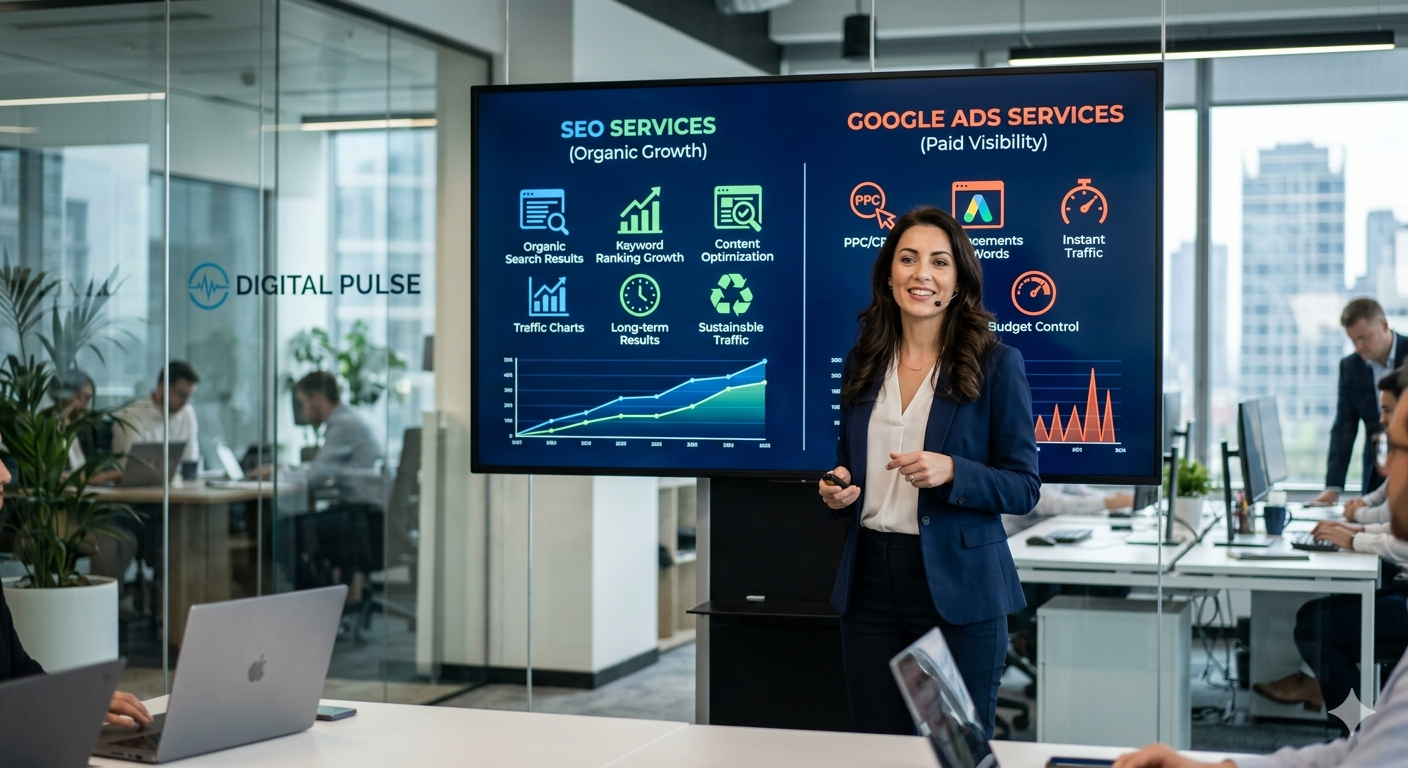
Which Businesses Should Use SEO?
SEO tends to make the most sense for:
- Local service businesses — plumbers, dentists, salons, electricians, law firms — where “near me” searches drive serious revenue
- Content-driven businesses — blogs, media sites, SaaS companies, course creators
- eCommerce stores with broad product catalogs and a long-term horizon
- B2B companies with long sales cycles, where buyers research extensively
- Established brands that want to defend their market position
- Startups with limited monthly budgets that can invest time and patience
If your business model depends on building a brand, attracting consistent inbound interest, and reducing acquisition costs over time, SEO is rarely the wrong call.
Which Businesses Should Use Google Ads?
Google Ads tends to make the most sense for:
- New businesses that need traction immediately
- Seasonal businesses (tax services, holiday retailers, event-based offerings)
- Promotions and product launches
- Local businesses in markets where SEO competition is brutal
- High-ticket service providers where one lead pays for many clicks
- Testing demand before investing in long-term content
- Geo-specific campaigns targeting one neighborhood or city
- Remarketing to people who have already visited your site
If you need predictable, controllable traffic now, paid search is built for exactly that job.
When Should Businesses Combine Both?
Honestly? Almost always — when the budget allows.
The most resilient digital marketing strategies I’ve seen pair the two like this:
- Google Ads handles the immediate revenue, especially for high-intent commercial keywords
- SEO handles the long-term cost reduction, slowly capturing the same keywords organically so paid spend can be redirected to new opportunities
- Remarketing ads stay focused on visitors who came in through organic traffic
- Content from SEO feeds better landing pages, which improve Google Ads Quality Scores and lower CPCs
This compound effect — where each channel makes the other cheaper and more effective — is the real reason mature marketers stop treating SEO and Google Ads as competitors.
Advantages and Disadvantages of SEO
Advantages
- Long-term, compounding traffic
- Stronger user trust
- Lower cost per visit over time
- Builds brand authority and topical relevance
- Works while you sleep — and after you stop paying
Disadvantages
- Slow to show results
- Vulnerable to Google algorithm updates
- Requires consistent investment in content and quality
- Harder to attribute revenue precisely
- Highly competitive niches can take years to crack
Advantages and Disadvantages of Google Ads
Advantages
- Immediate visibility and traffic
- Granular targeting (location, device, time, audience, intent)
- Easy to measure ROI per click and per conversion
- Excellent for testing offers and messaging quickly
- Total control over budget and pace
Disadvantages
- Costs never go down on their own — and often rise
- Traffic disappears the moment campaigns pause
- Click fraud and wasted spend are real risks if unmanaged
- Lower trust signal than organic for many users
- Requires constant optimization to stay efficient
Common Misconceptions
A few myths worth clearing up:
“SEO is free.” No. SEO doesn’t have a per-click cost, but it absolutely has labor, content, and time costs.
“Google Ads boosts your SEO rankings.” It doesn’t. Google has confirmed multiple times that paid campaigns don’t directly influence organic rankings — though they do help you learn which keywords convert, which feeds smarter SEO decisions.
“You can rank #1 in a month.” For low-competition, long-tail queries, sometimes yes. For commercial money keywords, rarely. Anyone promising guaranteed, quick rankings is selling you something you’ll regret.
“Google Ads is too expensive for small businesses.” Not necessarily. A well-structured campaign focused on tight, high-intent keywords can be affordable. Poorly structured campaigns waste money — that’s what’s actually expensive.
“SEO is dead because of AI.” SEO continues to evolve, not disappear. The tactics change; the underlying need for credible, useful, well-structured content does not.
Setting Realistic Expectations
Whichever path you choose, hold onto these realistic benchmarks:
- SEO usually takes 6 months before meaningful results, sometimes longer in competitive niches
- Google Ads usually needs 4–8 weeks of optimization before campaigns hit their efficient stride
- Conversion rates matter more than traffic volume — both channels fail without a strong website and offer
- Tracking, analytics, and attribution must be set up properly from day one
- Patience is the single most underrated marketing skill
Best Strategy for Small Businesses
If you’re running a small business with a modest budget, here’s a practical framework I’ve recommended often:
- Start with Google Ads on a small, focused budget targeting your highest-intent keywords — usually 3 to 10 of them.
- Use the data from those campaigns (which keywords convert, which messages resonate, which landing pages perform) to guide your SEO strategy.
- Invest in SEO simultaneously with content that supports those high-converting keywords.
- Gradually shift budget toward SEO as organic rankings improve, freeing up paid budget for new offers, locations, or markets.
- Keep a baseline of branded and high-intent ads running even after SEO matures — they protect your brand and capture buyers at the decision stage.
This phased approach reduces risk while building sustainable growth.
The Future of SEO and Paid Advertising
Search is changing faster than at any point in the last decade. AI-powered answers, conversational search, and zero-click results are reshaping how users interact with Google.
What this means in practice:
- SEO is moving toward depth over volume — well-researched, experience-rich content is increasingly rewarded over thin, mass-produced articles
- E-E-A-T signals matter more than ever — author expertise, real-world experience, and source credibility are now competitive differentiators
- Google Ads is leaning heavily on automation and AI — Performance Max, smart bidding, and broad match are pushing advertisers to provide better creative inputs and trust the system more
- First-party data and audience signals are becoming central to paid campaigns as third-party cookies fade
- Brand strength is the moat — businesses that build recognizable, trusted brands win across both channels
Both SEO and Google Ads will remain essential. The businesses that thrive will be the ones that stop seeing them as alternatives and start using them as complementary parts of a single strategy.
FAQ
Q: Is SEO better than Google Ads? Neither is universally better. SEO is better for long-term growth and lower cost-per-visit over time. Google Ads is better for immediate traffic, testing, and tightly targeted campaigns. Most successful businesses use both.
Q: How long does SEO take to work? For most businesses, meaningful SEO results show up between 4 and 9 months, with strong results typically appearing after 12 months of consistent effort. Highly competitive industries can take longer.
Q: Does running Google Ads help my SEO rankings? No. Paid ads don’t directly influence organic rankings. However, the data from Google Ads — keyword performance, click-through rates, conversion data — can inform a smarter SEO strategy.
Q: How much should a small business spend on Google Ads? A reasonable starting point is a focused budget targeting only your highest-intent keywords, with daily caps that protect your overall spend. The exact amount depends on your industry’s CPC, but starting small and scaling based on conversion data is usually wiser than starting big.
Q: Can I do SEO myself? You can handle basic on-page SEO and content publishing yourself, especially for a local business. Technical SEO, link building, and competitive content strategy usually benefit from professional help.
Q: Is SEO still relevant with AI-generated search results? Yes. AI-powered search still pulls from credible, well-structured web content. Quality, experience-based content is more important than ever — not less.
Q: What’s the cheapest way to get traffic from Google? Long-term, SEO is almost always the cheapest source of traffic per visit. Short-term, well-managed Google Ads targeting low-competition, high-intent keywords can be surprisingly affordable.
Q: Should I pause Google Ads once my SEO is ranking? Usually, no — at least not entirely. Even when you rank organically, keeping branded ads and a few high-intent campaigns running often increases total clicks and protects against competitors bidding on your brand.
Conclusion
The real difference between SEO services and Google Ads services isn’t about which is “better.” It’s about which one fits the stage your business is in, the speed at which you need results, and the kind of growth you’re building toward.
Google Ads gives you a faucet you can turn on tomorrow. SEO gives you a well that, with patience, keeps producing for years.
The smartest business owners I’ve worked with don’t pick a side. They use Google Ads to capture demand today and SEO to build an asset that pays them back tomorrow. If your budget allows for both, that combination is almost always the strongest play. If it doesn’t yet, start with the channel that matches your immediate need, but keep the other on your roadmap.
Whatever you choose, invest in quality. Cheap SEO and cheap ads both have a way of becoming the most expensive marketing you’ll ever pay for.